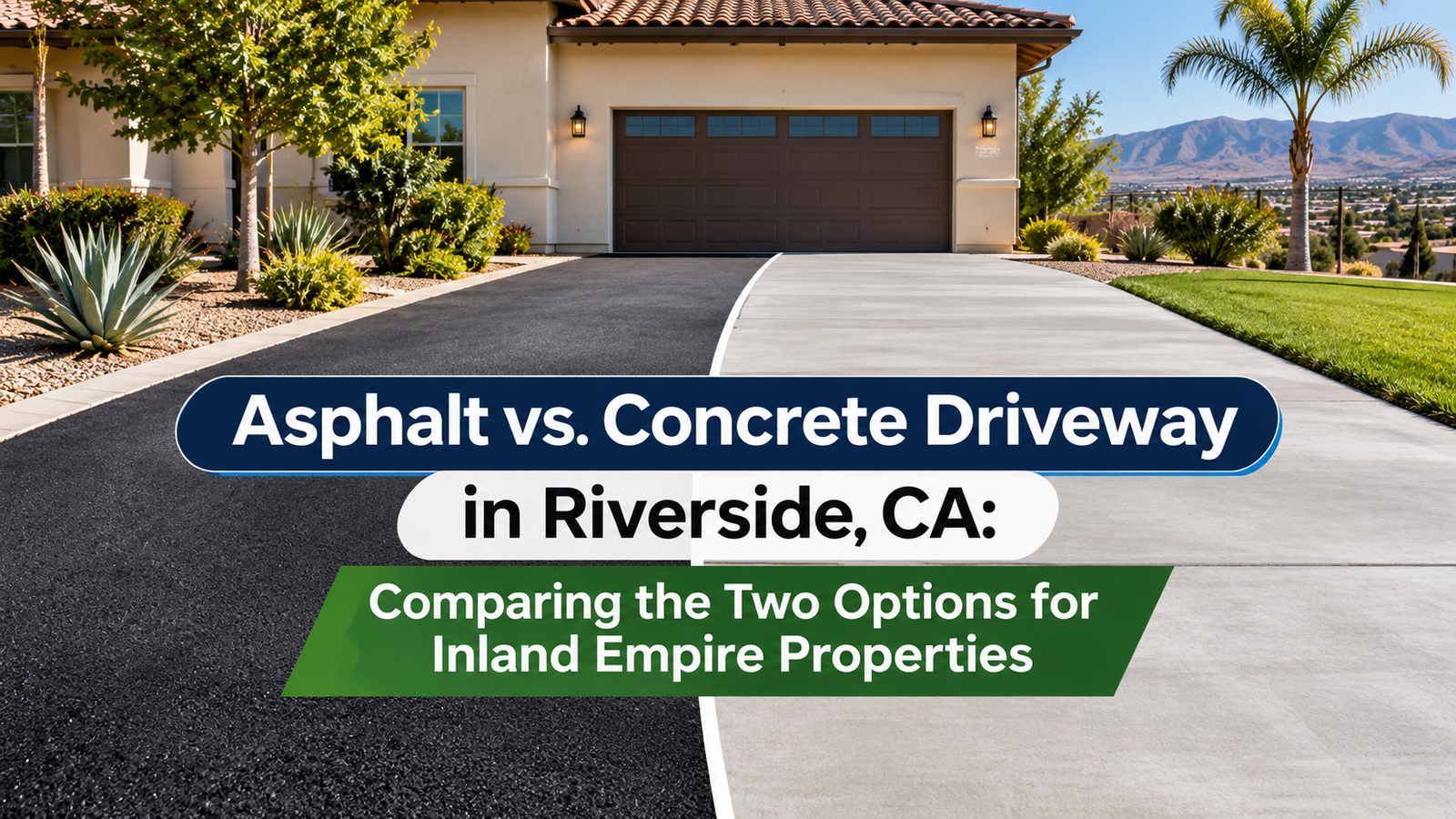
Riverside homeowners replacing a driveway or installing a new one face the fundamental choice between asphalt vs concrete driveway Riverside. Both are proven driveway materials with long track records in Southern California, but they perform differently in Riverside’s specific climate, they have different maintenance requirements, and they suit different property types and owner preferences. This guide compares the two materials across the factors that matter most to Riverside property owners: performance in the Inland Empire’s climate, longevity, maintenance requirements, appearance, and the regulatory and HOA factors that sometimes influence the choice.
Performance in Riverside’s Climate: Heat, Sun, and Minimal Freeze-Thaw
Riverside’s climate is defined by its extremes: extreme summer heat with temperatures regularly above 100°F, intense UV radiation from the inland sun, and relatively dry conditions with most of the modest annual rainfall (approximately 10 to 11 inches) falling between November and March. This climate profile affects asphalt and concrete in distinctly different ways.
Asphalt is vulnerable to Riverside’s heat and UV in a specific way: the petroleum-based binder that holds the aggregate together oxidizes under UV radiation and high temperatures, drying and hardening over time. Surface temperatures on dark asphalt in direct Riverside summer sun reach 150 to 180°F. This accelerates the aging process and can soften the top layer of asphalt during peak heat, making it susceptible to tracking under stationary vehicle loads. Sealcoating is the standard response to this the sealer provides UV protection and slows oxidation significantly.
Concrete is more resistant to UV oxidation than asphalt but has its own Riverside climate vulnerabilities. Concrete can develop alkali-silica reaction (ASR) a chemical reaction between reactive aggregates in the concrete and the alkaline cement paste that causes internal expansion and surface cracking over time. The alkaline soils common in some Riverside area locations can also cause sulfate attack on concrete, requiring sulfate-resistant cement formulations. Concrete in Riverside’s climate is generally very durable; the absence of freeze-thaw cycling eliminates the spalling that damages concrete in cold climates.
The absence of significant freeze-thaw in Riverside changes the relative comparison between asphalt and concrete compared to cold climates. In Pennsylvania or Michigan, concrete’s resistance to freeze-thaw damage gives it a significant durability advantage over asphalt. In Riverside, where freeze-thaw is essentially absent, this advantage disappears and the comparison becomes more balanced. Both materials can perform well for 20 to 30 years in Riverside’s climate with appropriate maintenance.
Service Life and Durability
Concrete driveways in Riverside, well-built with appropriate mix design, can last 30 to 50 years with minimal structural maintenance. The concrete’s rigid structure does not degrade with UV exposure the way asphalt does, and the absence of freeze-thaw damage means the typical failure modes settlement from soil movement, surface cracking from drying shrinkage or soil expansion, and discoloration are manageable. Structural cracking from expansive subgrade soils is a risk in some Riverside areas, and concrete’s rigidity means it cannot accommodate soil movement without cracking; asphalt’s greater flexibility allows it to deform slightly under soil movement without immediate visible cracking.
Asphalt driveways in Riverside, with regular maintenance (sealcoating every 3 to 5 years, crack filling as needed), typically last 20 to 30 years. The key to the upper end of that range is consistent maintenance a well-maintained Riverside asphalt driveway at 25 years can still have decades of additional life with an overlay resurfacing, while a neglected driveway may need full replacement at 15 years. The option to overlay placing a fresh 1.5 to 2 inch layer of asphalt over the existing surface is an intermediate step that extends service life without the full disruption and cost of replacement.
Repair options also differ between the two materials. Asphalt damage cracks, potholes, and surface deterioration is generally easier and less expensive to repair than equivalent concrete damage. Asphalt patches blend reasonably well with the existing surface and can be done incrementally. Concrete crack repair is more involved, and significant concrete damage typically requires saw-cutting and replacing panels rather than patching. For property owners who want lower ongoing repair complexity, asphalt’s repairability is an advantage.
Maintenance Requirements in the Inland Empire
Asphalt requires more frequent maintenance than concrete over its service life in Riverside. The sealcoating cycle every 3 to 5 years is the primary recurring maintenance activity. Each sealcoating involves cleaning the surface, filling any existing cracks, and applying the sealer, then keeping the driveway clear of vehicle traffic for 24 to 48 hours while it cures. For property owners comfortable with this maintenance cycle, it is straightforward; for those who prefer a lower-maintenance surface, it is a recurring obligation.
Concrete maintenance in Riverside is minimal by comparison. Surface cleaning to prevent staining, joint sealing every several years to maintain the expansion joint filler, and occasional crack repair if settlement or soil movement causes cracking are the primary activities. No sealcoating is required. Concrete stains more visibly than asphalt from oil and vehicle fluid drips these stains are more apparent on the lighter surface but concrete-specific degreasers and sealers (decorative concrete sealers are distinct from asphalt sealers) can help manage staining.
Appearance and Aesthetic Considerations
Appearance is a significant factor for many Riverside homeowners, particularly in the region’s upscale communities and planned developments where curb appeal and property presentation matter. The two materials have very different aesthetic profiles. Asphalt is uniformly dark when new and freshly sealed a classic utilitarian look that many property owners prefer for its clean, formal appearance. It fades to gray as it ages and oxidizes, which the sealcoat cycle addresses by restoring the dark color.
Concrete offers more design flexibility. The standard broom-finished concrete has a light gray appearance that complements a wide range of architectural styles. Stamped concrete can replicate stone, brick, slate, or tile patterns in a wide range of colors and textures. Exposed aggregate finishes reveal the natural character of the coarse aggregate in the mix, creating a more organic-textured surface. These decorative options make concrete the preferred choice for property owners who want a driveway that makes a design statement rather than simply functional infrastructure.
Many Riverside communities have HOA design standards that specify allowable driveway materials and finishes. Upscale planned communities sometimes prohibit asphalt in favor of concrete or pavers; others have no material restrictions. Property owners in HOA-governed communities should verify design requirements before making a material selection.
Practical Considerations Specific to Riverside
The Inland Empire’s hot summer climate creates one practical consideration specific to asphalt: the tendency for freshly installed or inadequately compacted asphalt to soften during peak summer heat, leaving tire marks or tracking under stationary vehicle loads. This is most pronounced in the first summer after installation, before the asphalt has fully cured and hardened. Concrete does not have this issue it maintains its structural rigidity regardless of summer surface temperatures.
Riverside’s expansive clay soils in some areas of the city create a subgrade movement consideration that affects both materials but in different ways. Asphalt’s flexibility allows it to deflect slightly over soil movement without immediate cracking, potentially developing gradual surface deformation instead. Concrete’s rigidity means it cracks across panel joints or mid-panel when the subgrade moves. The practical implication is that both materials can be affected by expansive subgrade soils, but the failure mode looks different.
Frequently Asked Questions: Asphalt vs. Concrete Driveway in Riverside, CA
Which driveway material lasts longer in Riverside asphalt or concrete?
Concrete generally has a longer service life 30 to 50 years with minimal maintenance, compared to 20 to 30 years for well-maintained asphalt. In Riverside’s mild freeze-thaw climate, concrete loses the freeze-thaw damage risk that shortens its life in cold climates, giving it a significant longevity advantage. Asphalt can extend its useful life further with an overlay resurfacing at the 15 to 20 year mark, which resets the surface without the cost of full replacement, so the total lifetime of an asphalt driveway with one overlay can approach concrete’s service life.
Does asphalt get too soft in Riverside’s summer heat?
Surface temperatures on dark asphalt in direct Riverside summer sun can reach 150 to 180°F, which does soften the top surface layer. For well-compacted, properly specified asphalt, this is usually a cosmetic concern rather than a structural one the surface may show tire marks under stationary vehicles in peak heat, but the driveway remains functional. Using a stiffer performance grade binder (PG 70-22 or PG 76-22 instead of PG 64-22) reduces heat susceptibility. New asphalt is most vulnerable in its first summer before it fully cures and hardens.
Can I add decorative stamping or coloring to a concrete driveway in Riverside?
Yes stamped and colored concrete is widely available from concrete contractors in the Inland Empire and is a popular option for Riverside residential driveways. Stamped concrete uses textured stamps pressed into the fresh concrete surface to create patterns resembling stone, slate, brick, or other materials. Integral color or surface-applied stains add color. The result can be a high-impact decorative surface for significantly less than actual stone or pavers. Property owners should verify any HOA design guidelines before selecting a stamped design.
Does my HOA in Riverside have any say in what driveway material I choose?
Many Riverside planned communities have HOA CC&Rs that specify allowable driveway materials, finishes, or dimensions. Some upscale communities require concrete or pavers and prohibit asphalt. Others specify minimum widths or prohibit certain stamped patterns. If your property is in an HOA, reviewing the CC&Rs and obtaining architectural committee approval before beginning driveway work is important non-approved installations can be required to be removed at the homeowner’s expense.